Private IPv4 Addressing
Introduction
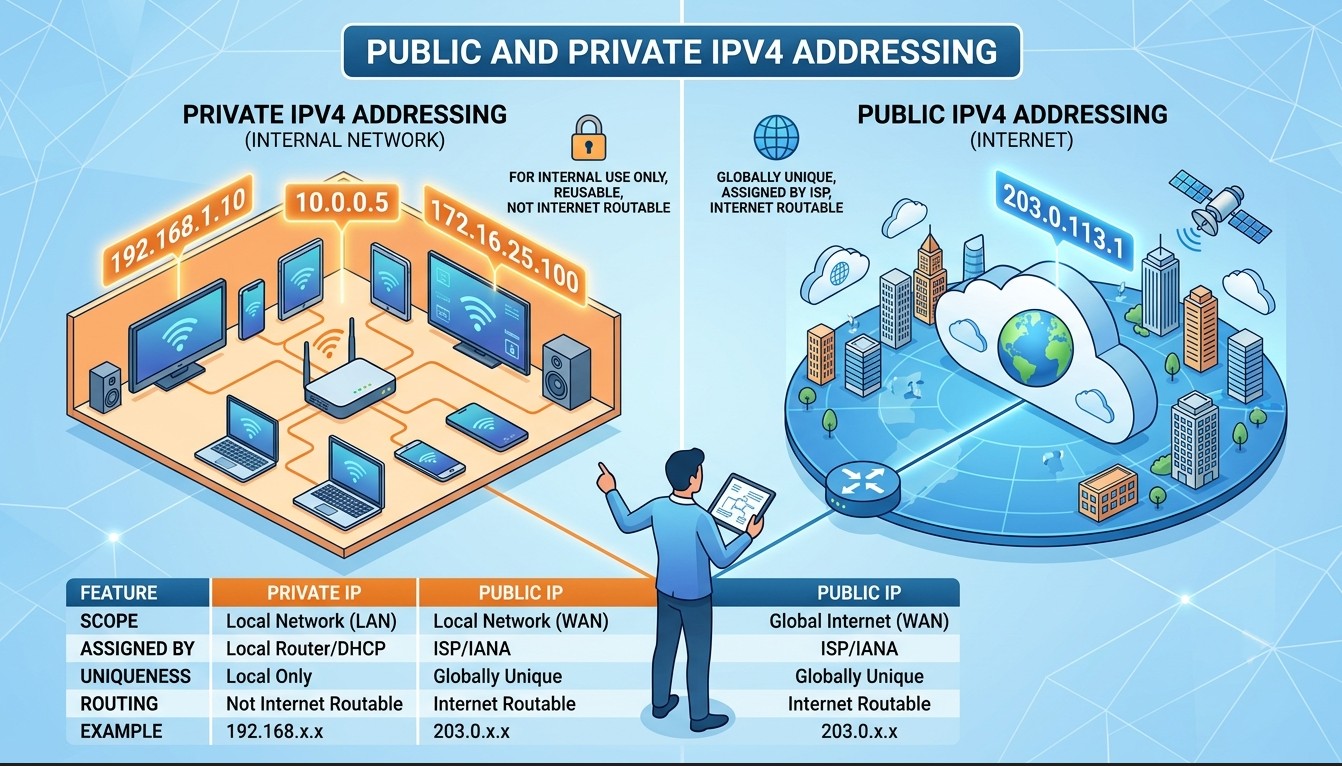
Private IPv4 addressing is a method of assigning IP addresses to devices within a private network, such as a home, office, school, or enterprise network. These addresses are intended for internal use only and cannot be directly accessed from the public Internet. The concept of private IP addressing was introduced to help conserve the limited number of available IPv4 addresses and to improve the security and management of local networks.
IPv4 Address and its Types
An IPv4 address is a 32-bit numerical identifier assigned to a device connected to a network. Every device that communicates over a network, such as a computer, smartphone, printer, server, or router, requires an IP address. Since the IPv4 address space is limited to approximately 4.3 billion addresses, it became necessary to develop methods to use addresses more efficiently. One of the most effective solutions was the introduction of private IP address ranges.
IP addresses can be broadly classified into two categories:
- Public IP Addresses
- Private IP Addresses
Understanding the difference between these two types is essential for network design, management, and security.
Public IPv4 Address
A public IP address is an IP address that is globally unique and accessible over the Internet. It is assigned by an Internet Service Provider (ISP) and is used to identify a device or network on the public Internet. Since public IP addresses are unique worldwide, no two devices on the Internet can have the same public IP address at the same time.
When a user accesses a website, sends an email, or uses any Internet-based service, the communication occurs through a public IP address. Public IP addresses allow devices and servers to communicate directly over the Internet.
Characteristics of Public IP Addresses
- A public IP address is globally unique across the Internet.
- It is assigned by an ISP.
- A public IP is routable on the Internet.
- It can be accessed from anywhere in the world.
- It is used by web servers, mail servers, and Internet-connected devices.
- Example of Public IP Addresses
- 8.8.8.8
- 1.1.1.1
- 142.250.190.78
Private IPv4 Address
Private IPv4 addresses are reserved for use within internal networks and are not routable on the public Internet. This means that Internet routers are configured to ignore packets originating from or destined for private IP addresses. As a result, organizations can use these addresses freely without obtaining them from an Internet Service Provider (ISP) or a regional Internet registry.
There are three ranges of private IPv4 addresses defined by the networking standards:
- 10.0.0.0 to 10.255.255.255 (10.0.0.0/8)
- Provides over 16 million addresses.
- Commonly used in large organizations and enterprises.
- 172.16.0.0 to 172.31.255.255 (172.16.0.0/12)
- Provides approximately 1 million addresses.
- Suitable for medium-sized networks.
- 192.168.0.0 to 192.168.255.255 (192.168.0.0/16)
- Provides 65,536 addresses.
- Widely used in home and small business networks.
For example, a home Wi-Fi router may assign the address 192.168.1.10 to a laptop and 192.168.1.20 to a smartphone. These devices can communicate with each other within the local network using their private IP addresses. However, when they need to access the Internet, they cannot use these private addresses directly because they are not recognized on the public Internet.
To enable Internet connectivity, networks use a process called Network Address Translation (NAT). NAT is typically performed by a router. When a device with a private IP address sends data to the Internet, the router replaces the private source address with its own public IP address. The router keeps track of the connection and ensures that responses from the Internet are delivered back to the correct internal device. NAT allows multiple devices within a private network to share a single public IP address, significantly reducing the demand for public IPv4 addresses.
Advantages of Private IPv4 Address
Private IPv4 addressing offers several important advantages.
- Private IP address helps conserve the limited pool of public IPv4 addresses by allowing many devices to share a smaller number of public addresses.
- It improves security because devices using private IP addresses are not directly reachable from the Internet. External users cannot access internal devices unless specific configurations, such as port forwarding, are implemented.
- Private addressing provides flexibility in network design because organizations can create and manage their own addressing schemes without relying on external authorities.
- Private addressing also simplifies network administration. Network administrators can organize devices into different subnets, departments, or locations using private address ranges. This improves network performance, enhances security, and makes troubleshooting easier.
- The same private address ranges can be reused by different organizations, companies do not need to worry about address conflicts with external networks.
Limitations of Private IPv4 Address
Despite its advantages, private IPv4 addressing has some limitations.
- Since private addresses are not globally unique, they cannot be used for direct communication over the Internet.
- NAT may also introduce additional complexity in certain applications that require end-to-end connectivity. Furthermore, managing large networks with extensive NAT configurations can become challenging.
Types of IPv4 Addresses based on its assignment
Dynamic IP (Changes)
A dynamic IP address changes periodically. Your Internet Service Provider (ISP) maintains a pool of IP addresses and automatically assigns one to your router when it connects. If you restart your router or your lease expires, you will likely get a different IP address from the pool.
- Best for: Standard home internet users.
- Pros: It is fully automatic, requires no setup, and is included in the base cost of your internet plan. It also offers a slight security benefit, as a changing IP address makes it harder for malicious actors to track or target your specific network over time.
- Cons: Because the address changes, it is difficult to reliably host a server or website from that connection.
Static IP (Permanent)
A static IP address never changes. Once your ISP assigns it to you, it remains the same permanently unless you cancel the service or specifically request a change.
- Best for: Businesses, remote workers, and anyone hosting a server.
- Pros: It provides a reliable, unchanging address. This is essential if you want to host a website, run an email server, set up a dedicated gaming server, or use reliable remote desktop access (like a VPN into an office).
- Cons: ISPs typically charge an extra monthly fee for a static IP. Because the address never changes, it is also a predictable target for hackers, requiring robust firewall security.
Comparison
| Feature | Dynamic IP | Static IP |
|---|---|---|
| Does it change? | Yes | No |
| Assignment | Automatic | Manual/Permanent |
| Typical User | Home networks, everyday browsing | Businesses, server hosting |
| Cost | Free (included with internet) | Usually an extra monthly fee |
| Setup | None required | Requires manual configuration |
Conclusion
In conclusion, private IPv4 addressing is a fundamental concept in modern networking that enables efficient use of IPv4 address space while providing enhanced security and simplified network management. By reserving specific address ranges for internal use and combining them with technologies such as NAT, organizations and individuals can build scalable and secure networks while conserving valuable public IP addresses. Private IPv4 addressing continues to play a vital role in network operations around the world, especially as IPv4 addresses remain a limited resource.