Switching Concepts in Networking
Introduction to Switching Concepts
Switching is a fundamental networking process that helps to transfer data efficiently among the devices within a Local Area Network (LAN). An Ethernet switch plays a very important role in switching operation at the Data Link Layer (Layer 2) of the OSI model
A switch uses MAC (Media Access Control) addresses to identify devices connected to the network. Unlike hubs, which broadcast data to all connected devices, switches intelligently forward data only to the intended destination based on the MAC address, thereby improving network performance and reducing unnecessary traffic.
To make forwarding decisions, a switch builds and maintains a MAC address table by learning the MAC addresses of devices connected to its ports. When a frame arrives, the switch examines the destination MAC address and consults its table to determine the appropriate outgoing port. If the destination address is known, the frame is forwarded directly to the correct port; if it is unknown, the switch floods the frame to all ports except the one on which it was received.
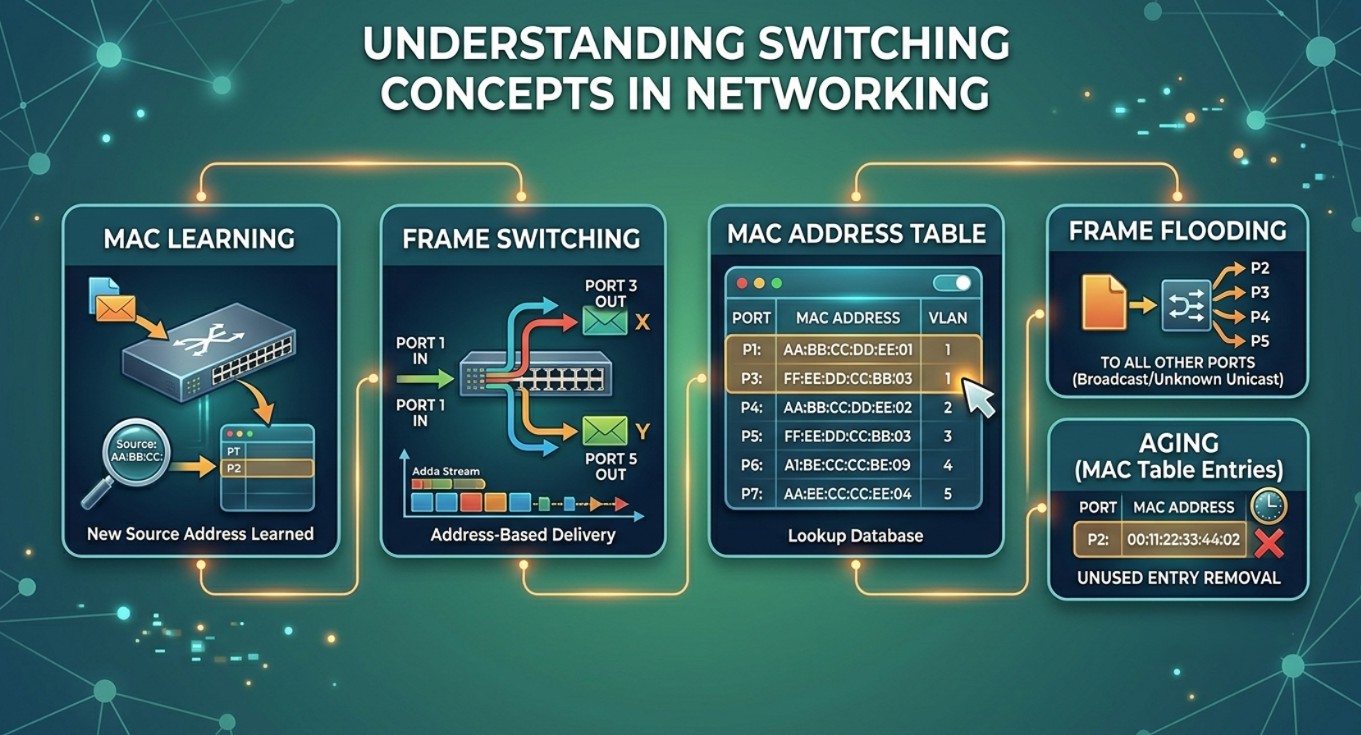
During the switching process, it undergoes numerous switching mechanisms that include MAC learning, MAC address aging, frame switching, frame flooding, and MAC address tables. Together, these mechanisms enable switches to efficiently manage network traffic, ensure accurate frame delivery, and maintain up-to-date information about connected devices, making modern Ethernet networks faster, more reliable, and scalable.
How Switching works in networking
A network switch forwards Ethernet frames between devices using MAC addresses. The complete switching process involves MAC learning, MAC table lookup, frame forwarding, and aging.
- Data Frame Arrival: When a device sends data, it is encapsulated into an Ethernet frame and transmitted to the switch.
- MAC Address Learning: The switch examines the source MAC address of the incoming frame and stores it in its MAC address table along with the port number.
- Looks for the destination MAC address: The switch examines the destination MAC address in the Ethernet frame and checks its MAC address table to determine which port the frame should be forwarded to.
- There may be two possibilities: the destination MAC address is found in the MAC table or not found.
- If the destination address is found in the MAC table, the switch forwards the frame only to the corresponding port that matches the destination MAC address. This is called frame switching or unicast forwarding.
- If the destination MAC address is not found in the MAC table, then the switch floods the frame out all ports except the incoming port. This process is called frame flooding.
- All connected devices receive the frame. Only the device whose MAC address matches the destination MAC processes the frame. All other devices discard it.
- The destination device sends a reply frame. The switch learns the destination device’s MAC address from the source MAC address in the reply and records the port it came from. The MAC address table is updated.
- Future frames are forwarded directly to the correct port instead of being flooded.
- MAC Aging: Each MAC table entry has an aging timer (commonly 300 seconds). If no frames are received from a device before the timer expires, the switch removes the entry.
MAC Learning and Aging
MAC learning is the process by which a switch automatically learns the MAC addresses of devices connected to its ports. When a frame enters the switch, it examines the source MAC address and records it along with the port on which the frame was received. This information is stored in the MAC address table and is used to forward future frames efficiently.
MAC aging is the process of removing inactive MAC address entries from the MAC address table after a specified period. This ensures that outdated or unused entries do not remain in the table indefinitely. By aging out old entries, the switch maintains an accurate and up-to-date record of devices connected to the network, improving switching efficiency and adaptability.
Frame Switching
Frame switching is the process by which a network switch forwards Ethernet frames from one port to another based on the destination MAC address. When a frame arrives, the switch examines the destination MAC address and searches its MAC address table to determine the correct outgoing port.
If the destination MAC address is found in the table, the switch forwards the frame only to the corresponding port. This targeted forwarding reduces unnecessary network traffic and improves communication efficiency. Frame switching enables fast and reliable data transfer between devices within a Local Area Network (LAN).
Frame Flooding
Frame flooding occurs when a switch receives a frame whose destination MAC address is not present in its MAC address table. Since the switch does not know which port the destination device is connected to, it sends a copy of the frame out of all ports except the port on which the frame was received.
Flooding is also used for broadcast frames, which are intended for all devices on the network. Once the destination device responds, the switch learns its MAC address and updates its MAC address table. This allows future frames to be forwarded directly to the correct port instead of being flooded across the network.
MAC Address Table
A MAC address table (also called the switching table or CAM (Content Addressable Memory) table) is a database used by a network switch to store information about devices connected to its ports. It contains the MAC addresses of devices and the corresponding switch ports where those devices can be reached.
The switch builds this table automatically using the MAC learning process. Whenever a frame arrives at a switch, it reads the source MAC address and records it along with the incoming port number. This allows the switch to quickly determine where to send future frames based on their destination MAC address.
Each entry in the MAC address table typically includes:
- MAC address of the device
- Switch port number
- Entry type (dynamic or static)
- Aging timer value
The switch uses this table to forward frames efficiently. If the destination MAC address is found in the table, the frame is sent only to the correct port. If it is not found, the switch floods the frame to all ports except the incoming port.
MAC address table entries are usually dynamic, meaning they are learned automatically and removed after a certain period of inactivity through MAC aging. Some entries can also be static, which are manually configured and do not expire.